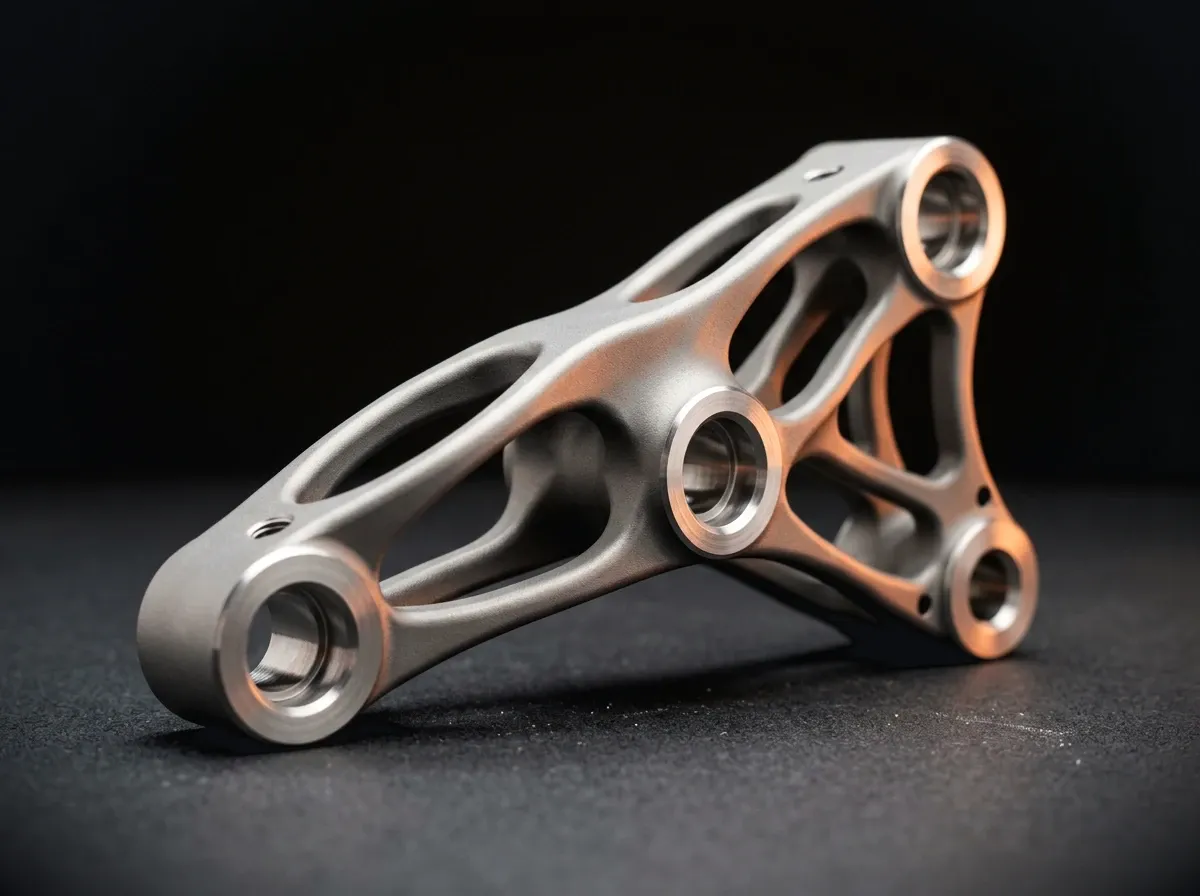
| Density (Ti-6Al-4V) | 4.43 g/cm³ Typical reference density |
|---|---|
| Steel comparison density | ~7.9 g/cm³ Approximate reference value |
| Machined tolerance | ±0.1 mm Standard |
| Precision machined tolerance | ±0.05 mm Precision option |
All specs (6)
| As-built surface tolerance | ±0.5 mm |
|---|---|
| Typical quantities | 1–200 No tooling |
Overview
Custom titanium parts are available on demand in Ti-6Al-4V Grade 5 or CP Grade 2. Ti-6Al-4V density is about 4.43 g/cm³ (CP Grade 2 about 4.51 g/cm³), compared with steel at about 7.9 g/cm³, supporting a high strength-to-weight ratio for brackets, space structures, and fluid fittings. Drop your CAD for a browser-based design check and quote.
Why choose titanium for custom parts?
Titanium’s density gives weight-conscious designs a useful starting point: Ti-6Al-4V density is about 4.43 g/cm³ (CP Grade 2 about 4.51 g/cm³), roughly 56% of steel’s approximate 7.9 g/cm³ reference value. Lower density does not remove the need to check stiffness, loads, temperature, interfaces, and fatigue requirements, but it can help reduce mass when the design uses the material effectively.
Aerospace brackets often benefit from this strength-to-weight balance. Space structures can use titanium where low mass, corrosion resistance, and stable interfaces matter. Fluid fittings can benefit from titanium’s corrosion resistance, with the fluid, pressure, temperature, and applicable specification defined before release. Compare the choice with stainless steel when mass is less important than a different combination of cost, strength, or corrosion performance.
Ti-6Al-4V vs CP Grade 2: which fits the part?
Ti-6Al-4V Grade 5 and CP Grade 2 serve different design priorities. Ti-6Al-4V is the common starting point for structural parts where strength-to-weight is central. CP Grade 2 is commercially pure titanium, often considered when ductility and corrosion resistance matter more than maximum structural strength.
| Grade | Design emphasis | Typical use |
|---|---|---|
| Ti-6Al-4V Grade 5 | High strength-to-weight and structural capability | Aerospace brackets and space structures |
| CP Grade 2 | Ductility, corrosion resistance, and lower alloy content | Fluid fittings and corrosion-conscious hardware |
Material selection should follow the load case and environment, not a grade name alone. State the grade, required condition, temperature range, fluid exposure, and critical interfaces in the drawing or quote. If the decision is uncertain, contact us with the application details and compare the result with the manufacturability check.
How fast can titanium aerospace brackets be delivered?
Lead time for titanium aerospace brackets depends on part size, geometry, quantity, and selected post-processing. Parts are made in under 1 day; delivery can be next day up to 5 days depending on part size. The exact date comes with the instant quote, and quantities from 1 to 200 are supported without tooling. See the lead-time guidance for planning assumptions.
Fast iteration starts with a complete CAD model. Drop STL, STEP/STP, 3MF, or OBJ files into the browser; files are analyzed locally and never leave your device. The instant manufacturability verdict arrives in under 60 seconds and explains why a design cannot be made, with a suggested fix where applicable. Start with how it works, then request a titanium quote.
What design notes matter for titanium parts?
Titanium part design should separate structural surfaces from datums and interface features. Define load direction, expected temperature range, hole sizes, fastener interfaces, critical dimensions, and inspection requirements. Use enough section thickness for the intended stiffness and avoid unnecessarily tight internal corners where the design allows.
Tolerance and surface requirements should be explicit. Machined features are ±0.1 mm standard or ±0.05 mm precision; as-built surfaces are ±0.5 mm. Machined surface finish is Ra 3.2 µm standard, with Ra 1.6 µm optional; as-built surfaces are Ra 12–25 µm. Mark which faces, holes, and interfaces need precision machining, and which surfaces can remain as-built, polished, or media-blasted.
Mesh2Metal describes the part route simply: additive manufacturing builds near-net shape geometry; precision machining brings specified interfaces to dimension; inspection checks the result; and a quality certificate records the evidence. The design file should make each required stage and acceptance limit clear. Review part manufacturability before finalizing narrow features or difficult access.
What post-processing is typical for titanium?
Post-processing for titanium parts typically includes stress relief and heat treatment when the design or material specification calls for them. The selected treatment depends on the grade, geometry, section thickness, and required properties. Put the required condition and any test or documentation needs in the quote request so the acceptance basis is clear.
Precision machining can finish critical interfaces after the near-net shape is built. Polished and media-blasted finishes can be considered where appearance, cleaning, or contact requirements call for them. Inspection then checks dimensions and deviations against the CAD definition. Read the quality documentation guidance before choosing acceptance criteria.
What does the titanium quality certificate include?
Quality documentation for titanium parts should connect the delivered part to its material and CAD definition. Every part ships with a quality certificate covering chemical composition, porosity and defect map, 3D deviation from CAD, mechanical properties, thermal properties, traceability, and certificate of conformance.
Titanium composition records typically report the grade and chemistry, including oxygen and other interstitial elements when required by the applicable material specification. Nitrogen, carbon, and hydrogen may also be listed as controlled interstitial values. State any customer-specific limits, heat-treatment condition, finish, or inspection requirement before the instant quote; the quality page explains the standard record.
How do I start a custom titanium parts quote?
The fastest start is a complete CAD file plus a clear part brief. Include the selected grade, quantity, critical dimensions, load or pressure context, temperature range, fluid exposure where relevant, post-processing, finish, and certificate requirements. Request a quote after the browser check, or review the FAQ for common ordering questions.
For export-controlled work, please do not send export-controlled (ITAR/EAR) technical data until a compliant path has been set up with you; contact us first.
Grades
Confirmed per quote Availability is confirmed for each part with its quote.| Grade | Density |
|---|---|
| Ti-6Al-4V (Grade 5) | 4.43 g/cm³ |
| CP titanium (Grade 2) | 4.51 g/cm³ |
Questions
What is the best titanium grade for aerospace brackets?
Ti-6Al-4V Grade 5 is usually the starting point when high strength-to-weight matters. CP Grade 2 can suit designs where corrosion resistance and ductility carry more weight.
Can titanium parts receive heat treatment?
Yes. Stress relief and heat treatment are typical post-processing options, selected according to the grade, geometry, and required properties.
What documentation comes with a titanium part?
Every part ships with a quality certificate covering chemical composition, inspection results, relevant properties, traceability, and certificate of conformance. Oxygen and other interstitial values are typically reported when required by the material specification.
How quickly can custom titanium parts be delivered?
Parts are made in under 1 day, with delivery from the next day up to 5 days depending on part size. The exact date comes with the instant quote.
Sources (4)
- [1] Ti-6Al-4V , Wikipedia
- [2] Titanium , Wikipedia
- [3] Machining , Wikipedia
- [4] Certificate of conformance , Wikipedia