| Manufacturability verdict | under 60 seconds |
|---|---|
| Part quantity | 1–200 parts |
| Maximum standard size | 800 × 800 × 600 mm |
| Machined tolerance | ±0.1 mm standard |
All specs (6)
| As-built tolerance | ±0.5 mm |
|---|---|
| Delivery | next day–5 days |
Overview
Need rapid prototyping metal parts for defense or dual-use programs? Mesh2Metal analyzes STL, STEP/STP, 3MF and OBJ locally in your browser; nothing leaves your device. A manufacturability verdict arrives in under 60 seconds. Parts are made in under 1 day, with delivery next day to 5 days depending on size; the exact date comes with the instant quote.
Export-control note: Please don’t send us export-controlled (ITAR/EAR) technical data until we have set up a compliant path with you — contact us first.
Can you make obsolete metal spare parts fast?
Obsolete metal spare parts are a practical starting point for on-demand work. Drop an approved CAD model, check the manufacturability verdict, and see where the design needs attention before requesting a quote. No tooling is required, so a sustainment team can evaluate one part or a small quantity without committing to a long run. The service supports quantities from 1 to 200.
A current model is not always available. If your team has an approved drawing or a measured reference, use it to create a CAD file through your normal engineering process, then check the resulting geometry in the browser. Mesh2Metal says exactly why a design cannot be made and how to fix it when the verdict is not favorable.
Which defense and dual-use parts fit the service?
Defense and dual-use programs commonly need brackets, covers, mounts, housings, adapters, access panels, test fixtures, and fit-check hardware. Ground vehicle teams can iterate service hardware around a revised interface. Maritime teams can evaluate covers, supports, and corrosion-conscious material choices. Prototype teams can move a design review forward with a metal part instead of waiting for a large batch.
Use cases include:
- Sustainment and obsolete spares: Recreate a low-volume legacy part from an approved CAD model, with quantities from 1 to 200.
- Rapid prototypes: Check a new enclosure, mount, or structural interface before a design review.
- Test fixtures: Request alignment plates, protective covers, and repeatable fit-check hardware.
- Ground vehicle hardware: Iterate brackets, housings, guards, and access hardware around field changes.
- Maritime hardware: Evaluate supports, covers, and service parts for vessels and shore equipment.
How are design files handled?
Design files are analyzed locally in the browser. Nothing leaves your device. STL, STEP/STP, 3MF, and OBJ are supported, and the in-browser check returns a manufacturability verdict in under 60 seconds. That local path is useful when an engineering team wants to inspect geometry before requesting a quote; CAD files stay on your device.
The manufacturability page explains the checks and common design fixes. When you are ready, request a quote. The export-control note above applies before any export-controlled (ITAR/EAR) technical data is shared; contact us first if you need to set up a compliant path.
Which materials and tolerances suit a part?
Material selection depends on the part’s loads, temperature, corrosion exposure, and electrical needs. Available families include aluminum, copper, stainless steel, titanium, nickel, and tool steel. Examples include AlSi5-class and AlSi12-class aluminum, CuCrZr and copper-nickel 70/30, 316L and 17-4 PH stainless, Ti-6Al-4V Grade 5, Alloy 625 and Alloy 718, plus H11 and H13 tool steel. Review aluminum materials, stainless steel materials, and titanium materials for starting points.
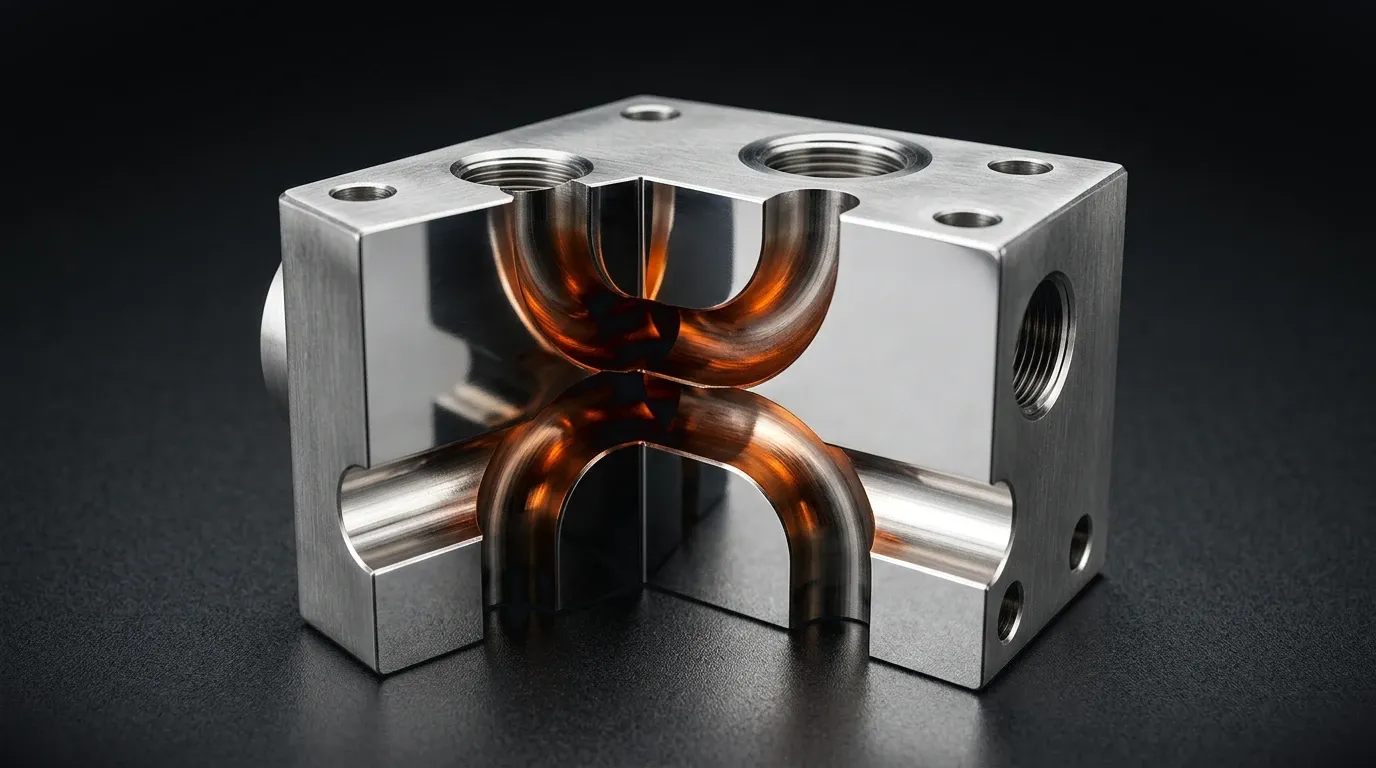
Mesh2Metal uses additive manufacturing: parts are built near-net shape, then receive precision machining where the design calls for tighter features. Standard machined tolerance is ±0.1 mm; precision machining can reach ±0.05 mm. As-built surfaces are ±0.5 mm. Machined surface finish is Ra 3.2 µm standard, with 1.6 µm optional; as-built surfaces are Ra 12–25 µm. Review quality expectations before specifying interfaces.
What arrives with each defense part?
Every part ships with a quality certificate. The certificate includes chemical composition, porosity and defect map, 3D deviation from your CAD, mechanical properties, thermal properties, traceability, and certificate of conformance. Inspection data gives engineering and procurement teams a concise record to review against the part definition.
The how it works page shows the sequence from browser check to quote and delivery. State the important features, tolerances, surface finish, and material in the part definition so the quote reflects the intended use.
How should teams plan prototype and sustainment timing?
Part timing depends on size. Use these planning points when a program needs a prototype, test fixture, or obsolete spare:
| Planning item | Mesh2Metal detail |
|---|---|
| Browser verdict | Under 60 seconds |
| Part quantity | 1–200 |
| Maximum standard size | 800 × 800 × 600 mm |
| Part timing | Made in under 1 day |
| Delivery | Next day to 5 days, depending on size |
| Tooling | None |
Use the lead times page for planning and request an instant quote when geometry is ready. Teams that need repeated design checks during iteration can review API and MCP access; accounts open soon through the waitlist.
Typical parts
Sustainment and obsolete spares
Sustainment teams can check an approved CAD model for a legacy bracket, cover, adapter, or other low-volume spare without new tooling. Quantities from 1 to 200 support a short run while a legacy part is being evaluated.
Rapid prototypes
R&D teams can check a new enclosure, mount, or structural interface before a design review. A metal prototype gives the team a physical reference for fit and function.
Test fixtures
Test teams can request alignment plates, protective covers, and repeatable fit-check hardware for a new assembly or revised interface.
Ground vehicle hardware
Ground vehicle programs can iterate brackets, housings, guards, and access hardware around field changes without commissioning new tooling.
Maritime hardware
Maritime programs can evaluate supports, covers, and service parts for vessels and shore equipment while comparing material choices for the environment.
Questions
Which CAD files can I use?
STL, STEP/STP, 3MF and OBJ files are analyzed locally in the browser and never leave your device.
Can I order a single part?
Yes. Quantities range from 1 to 200, with no tooling required.
What size limit applies?
The standard maximum part size is 800 × 800 × 600 mm; larger parts are available on request.
What does the quality certificate include?
Every part ships with a quality certificate covering composition, defect mapping, deviation from CAD, properties, traceability and conformance.
Sources (4)
- [1] Additive manufacturing , Wikipedia
- [2] Machining , Wikipedia
- [3] Surface roughness , Wikipedia
- [4] Certificate of conformance , Wikipedia