| Manufacturability verdict | Under 60 seconds The result explains why a design can or cannot be made. |
|---|---|
| Part size | 800 × 800 × 600 mm Larger parts on request. |
| Quantity | 1–200 parts No tooling required. |
| Machined feature tolerance | ±0.1 mm ±0.05 mm precision option. |
All specs (5)
| As-built surface tolerance | ±0.5 mm Machined surfaces have separate tolerances. |
|---|
Overview
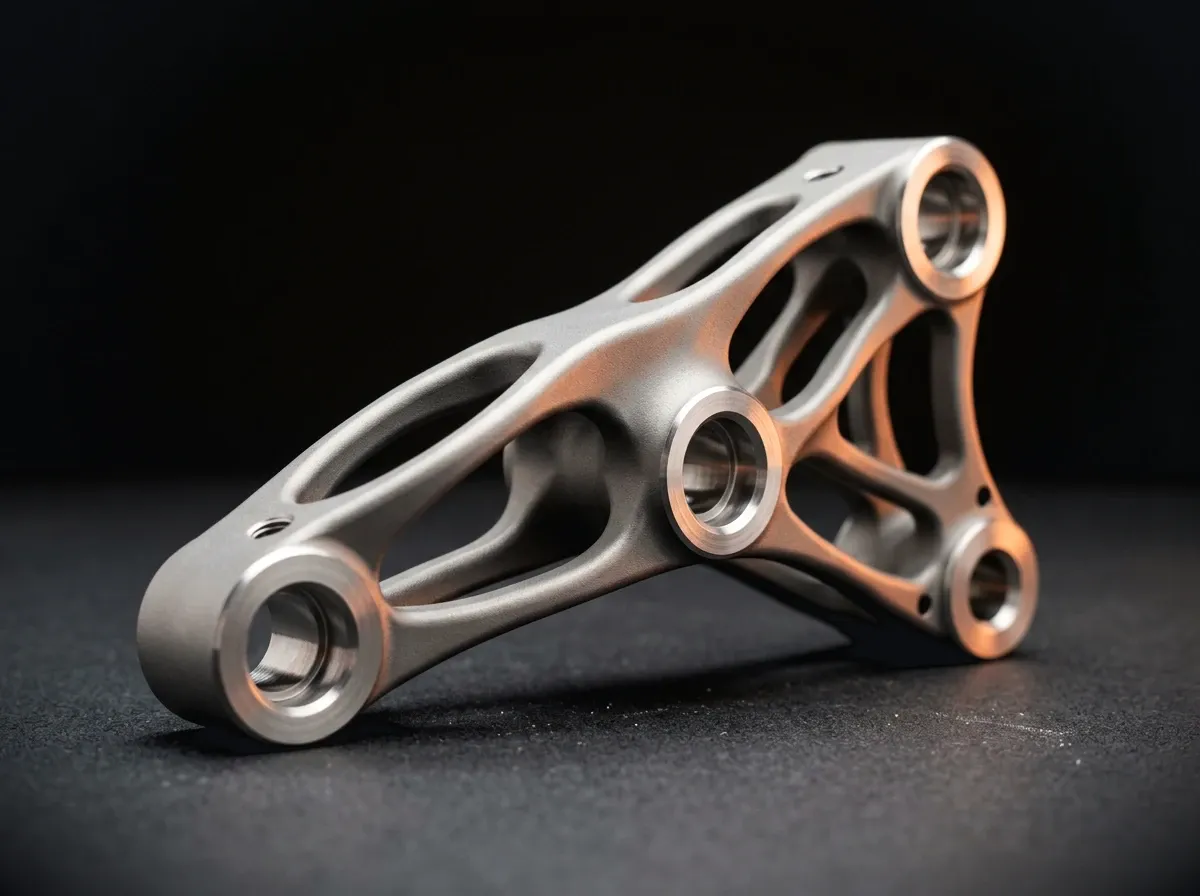
Aerospace prototype metal parts fast starts with a local CAD check. Mesh2Metal analyzes STL, STEP/STP, 3MF, or OBJ in your browser, returns a manufacturability verdict in under 60 seconds, and can make parts in under 1 day. Delivery is next day to 5 days, depending on part size, with the exact date in the instant quote.
Why do South Bay aerospace teams choose a local metal-parts workflow?
South Bay aerospace teams work close to a dense aerospace and space ecosystem in El Segundo, Los Angeles, next to LAX. Local proximity helps engineers iterate on brackets, fittings, manifolds, ducts, ground support equipment, tooling, and flight-test hardware without waiting for a conventional tooling cycle.
Mesh2Metal keeps the first design check in the browser. CAD files are analyzed locally and never leave the visitor’s device. Drop your CAD, check the geometry, and use the manufacturability verdict to see exactly why a design can or cannot be made. The instant quote shows the date and quantity options.
What aerospace parts can Mesh2Metal make?
Aerospace part programs often need a small quantity before a final design is settled. Brackets and fittings can support early packaging, access, and routing studies. Manifolds and ducts can help validate flow paths and interfaces. Ground support equipment and tooling can give test teams a right-sized physical article. Flight-test hardware can move from CAD review to a checkable part while the design is still changing.
Quantities run from 1 to 200 and no tooling is required. The standard maximum part size is 800 × 800 × 600 mm, with larger parts on request. The how-it-works guide explains the path from local geometry check to part delivery.
Which metals fit aerospace prototype and flight-test work?
Material selection depends on temperature, corrosion exposure, mass, stiffness, and the drawing requirements for the part. Titanium options include Ti-6Al-4V Grade 5 and CP Grade 2. Nickel options include Alloy 625 and Alloy 718 for demanding service environments. Stainless options include 316L, 304L, 17-4 PH, duplex 2205-class, 410, and 420.
The available range also includes aluminum, copper, and tool steel, and up to 3 alloys can be used in one part. Review the titanium materials, nickel alloys, and stainless steel materials pages with your engineering requirements before choosing a grade.
| Design check | Available specification |
|---|---|
| Machined feature tolerance | ±0.1 mm standard; ±0.05 mm precision |
| As-built surface tolerance | ±0.5 mm |
| Surface finish | Machined Ra 3.2 µm standard, 1.6 µm optional; as-built Ra 12–25 µm |
| Part envelope | 800 × 800 × 600 mm; larger on request |
| Quantity | 1–200 parts; no tooling |
| Material range | Ti, Ni, stainless, aluminum, copper, and tool steel |
What certificate data helps engineering review?
Certificate data gives engineering reviewers a defined evidence set for each part. Every part ships with a quality certificate covering chemical composition, porosity and defect map, 3D deviation from your CAD, mechanical properties, thermal properties, traceability, and certificate of conformance. These records help reviewers compare the delivered part with design intent and retain a clear package for internal review.
Certificate data supports review; it does not replace your program’s own acceptance criteria, controlled drawing requirements, or approval process. Use the quality evidence page to see the evidence categories. For a design that combines materials, review the multi-material workflow.
How fast can teams get flight-test hardware in Los Angeles?
Flight-test hardware programs in Los Angeles often change after fit checks. Mesh2Metal returns a manufacturability verdict in under 60 seconds, makes parts in under 1 day, and provides delivery from the next day up to 5 days depending on part size. The exact date appears with the instant quote; see lead times for the planning details.
Parts use additive manufacturing to be built near-net shape, followed by precision machining where dimensions require it, then inspection and a quality certificate. API and MCP access support fast design iteration, free up to approximately 100 checks per day per user; accounts open soon through the waitlist.
How should aerospace teams handle controlled technical data?
Export-controlled data requires a compliant path before it is shared. Please don’t send us export-controlled (ITAR/EAR) technical data until we have set up a compliant path with you — contact us first.
For ordinary early-stage geometry, local browser analysis keeps CAD on the visitor’s device. The Los Angeles workflow explains the local context, while contact is the right starting point for questions about a project.
What is the next step for an aerospace part review?
An aerospace engineering team can drop a CAD file into the browser, check the manufacturability result, compare material options, and request an instant quote. Start with the quote page, then use the result to align part size, alloy, tolerances, finish, quantity, and review evidence before the next design discussion.
Typical parts
Brackets and fittings
Validate packaging, access, and routing concepts with small-run brackets and fittings in the selected alloy.
Manifolds and ducts
Check flow-path layouts and interfaces with physical manifolds and ducts before a design is ready for a larger build.
Ground support equipment and tooling
Create right-sized hardware and tooling for test, inspection, and maintenance activities without a new tooling investment.
Flight-test hardware
Move changing flight-test designs into checkable physical articles for fit, function, and engineering review.
Questions
Can I begin with a local CAD check?
Yes. STL, STEP/STP, 3MF, and OBJ files are analyzed in the browser and never leave the visitor's device.
What quantities can an aerospace team request?
Quantities range from 1 to 200 parts, and no tooling is required. The standard maximum part size is 800 × 800 × 600 mm, with larger parts available on request.
Which data comes with each part?
Every part ships with a quality certificate covering composition, defect mapping, 3D deviation, properties, traceability, and certificate of conformance.
How should a team handle export-controlled data?
Contact us before sending controlled technical data so a compliant path can be set up first.
Sources (4)
- [1] Ti-6Al-4V , Wikipedia
- [2] Stainless steel , Wikipedia
- [3] Certificate of conformance , Wikipedia
- [4] El Segundo , Wikipedia